- Home
- About Us
- Products
- HOT
- Applications
- News & Media
- Contact Us
Views: 0 Author: Site Editor Publish Time: 2025-12-04 Origin: Site
For fleet managers, trailer owners, and commercial vehicle technicians, navigating trailer lighting regulations can feel like deciphering a foreign language—especially when it comes to SAE J759 lighting identification codes. These codes (like P2, PC, P3, and PC2) dictate which lights are legal for your trailer’s width, function, and mounting location, and non-compliance can lead to costly fines, safety hazards, or failed inspections.
Beyond regulatory headaches, choosing the right trailer lights directly impacts visibility, road safety, and long-term maintenance costs. In this guide, we’ll break down trailer lighting legal requirements, demystify SAE J759 codes, compare PC-rated combination lights to traditional options, and outline how to choose compliant, high-performance lighting for your fleet or personal trailer.
Before diving into codes, it’s critical to understand why trailer lighting rules exist—and what’s at stake if you ignore them. Federal Motor Vehicle Safety Standard (FMVSS-108) and SAE J759 standards aren’t arbitrary: they’re designed to make trailers visible to other drivers, define vehicle perimeters, and prevent collisions, especially in low-light or high-traffic conditions.
Non-compliant lighting can result in:
• Fines up to $500 per violation (depending on state and federal enforcement).
• Failed DOT inspections, which can ground your trailer until issues are fixed.
• Increased collision risk: Poorly marked trailers are 3x more likely to be involved in side-swipe or rear-end accidents, per NHTSA data.
• Maintenance delays: Mismatched lights (e.g., using a P2 where a PC is required) often require retrofits, wasting time and labor.
The first step to compliance? Knowing your trailer’s width—this is the foundation of all trailer lighting requirements.
Trailer lighting rules are split into two core categories, based on the trailer’s maximum width. These requirements are mandated by FMVSS-108 and enforced by state and federal transportation agencies.
Trailers Under 80 Inches Wide: Baseline Visibility Needs
For smaller trailers (common for utility, cargo, and personal use), the minimum lighting setup includes:
• Tail lights, stop lights, and turn signals: One set on each rear corner, visible from 500 feet in clear conditions.
• Side marker lights & reflectors: One amber side marker light and one amber reflector per side, mounted midway along the trailer’s length. Longer trailers (over 30 feet) require additional markers every 20 feet.
• License plate light: A white light illuminating the license plate, visible from 50 feet.
• Rear reflectors: Two red reflectors on the rear corners, visible from 300 feet.
These trailers rely on standard SAE-rated lights (most often P2-class) to meet baseline compliance.
Trailers Over 80 Inches Wide: Enhanced Perimeter Marking
Wider trailers (e.g., semi-trailers, flatbeds, and large equipment haulers) need extra lighting to communicate their full width to other drivers. In addition to the requirements for smaller trailers, they must include:
• Three red identification lights: Mounted in a horizontal bar across the rear top edge, spaced equally (at least 6 inches apart) to show the trailer’s width.
• Clearance lights: Amber lights on the front corners and red lights on the rear corners, mounted as far outboard as possible (typically on fenders or frame corners). These lights define the trailer’s maximum width, visible from 500 feet.
For these wide trailers, combination lights (like PC-rated options) are often the most practical and compliant choice—we’ll break down why below.
SAE J759 is the industry standard that assigns 2-letter/number codes to trailer lights, specifying their function, output, and legal application. These codes are printed on light lenses or packaging, and understanding them is key to choosing the right light for your trailer.
P2: The Baseline Compliance Standard (For All Trailers)
P2 is the most common SAE code—and the minimum legal standard for clearance, sidemarker, or identification lights (regardless of trailer width).
Key details about P2-rated lights:
• They’re approved for both trailers under 80 inches wide (their primary use case) and over 80 inches wide (as a secondary light, if needed).
• FMVSS-108 does not require stricter standards for smaller trailers, so P2 remains the default baseline.
• Every light from leading manufacturers (like Truck-Lite) meets P2 standards—even if the light is labeled with a higher code (e.g., PC or P3).
P2 lights are single-function (either clearance or sidemarker), so you’ll need two separate lights to cover both functions on wide trailers.
PC: Combination Clearance & Sidemarker Lights (For Wide Trailers)
PC-rated lights are a game-changer for trailers over 80 inches wide: they combine clearance and sidemarker functions into one unit, eliminating the need for two separate lights.
How PC-rated lights work:
• Mounting requirement: They must be installed on a 45° beveled corner (the edge where the trailer’s side and front/rear meet). This angle allows the light to emit a 90° beam pattern (45° along the side, 45° along the front/rear)—covering both clearance and sidemarker visibility needs.
• Legal flexibility: A PC-rated light can be used anywhere a P2 light is required (making it a versatile upgrade for smaller trailers, too). However, you cannot use a P2 light in place of a PC light on wide trailers (since P2s are single-function).
The biggest benefits of PC-rated lights? Reduced installation time (one light instead of two), fewer maintenance points, and a cleaner, more streamlined trailer exterior.
P3: Enhanced Output for Wide Trailers (Optional SAE Standard)
P3-rated lights are an optional upgrade for trailers over 80 inches wide, offering wider light output angles than P2 lights (for better visibility in low-light conditions).
Key notes about P3 lights:
• They’re legal for any application where a P2 light is used, but they’re optimized for wide trailers that need extra visibility.
• FMVSS-108 has not yet adopted P3 as a mandatory standard, so many manufacturers (including some Truck-Lite models) do not produce P3-compliant lights. Always check the lens marking before purchasing.
P3 lights remain a niche option—most fleets stick to PC or P2 lights due to their broader availability and FMVSS approval.
PC2: High-Angle Combination Lights (Optional SAE Standard)
PC2-rated lights are an advanced version of PC lights, designed for wide trailers that need extended beam angle coverage (beyond the 90° pattern of standard PC lights).
Like P3 lights:
• They must be mounted on a 45° beveled corner to function as combination clearance/sidemarker lights.
• FMVSS-108 has not yet recognized PC2 as a mandatory standard, so they’re considered an “optional” SAE upgrade.
• Some manufacturers (including select BTW models) do not produce PC2-compliant lights, so verify markings before buying.
PC2 lights are ideal for large, specialized trailers (e.g., oversized equipment haulers) that need maximum visibility, but they’re not required for most standard wide trailers.
To understand why PC-rated lights are growing in popularity for wide trailers, let’s break down how they stack up against traditional single-function lights (P2-rated clearance + P2-rated sidemarker).
Traditional P2 Light Setup (Two Separate Lights)
For a wide trailer’s front corner, a traditional setup requires:
• One P2-rated clearance light: Mounted on the front edge, emitting a 45° beam forward.
• One P2-rated sidemarker light: Mounted on the side edge, emitting a 45° beam along the trailer’s length.
This setup has two key drawbacks:
1. More installation work: You need to drill two mounting holes, run two sets of wiring, and secure two separate lights—adding time and labor costs.
2. More maintenance points: Two lights mean twice the risk of bulb burnout, wiring issues, or lens damage.
PC-Rated Light Setup (One Combination Light)
A PC-rated light replaces both traditional lights with a single unit:
• Beam pattern: A 90° combined beam (45° forward, 45° along the side), meeting both clearance and sidemarker visibility requirements.
• Installation: One mounting hole, one wiring harness, and one light to secure—cutting installation time by 50% or more.
• Maintenance: Fewer components mean fewer breakdowns and lower long-term costs.
As the diagram (above) illustrates:
• Traditional lights each emit a 45° beam (one for front, one for side).
• PC-rated lights emit a single 90° beam that covers both areas, all from one unit.
While SAE J759 defines lighting codes, FMVSS-108 is the federal rule that dictates which codes are legally required for on-road use. Here’s what you need to know about the current landscape and upcoming changes:
Current FMVSS-108 Requirements
• Only P2 and PC codes are recognized as mandatory standards for trailer lights. P3 and PC2 are considered “optional” SAE upgrades (not required by federal law).
• FMVSS-108 does not require lens markings (e.g., P2, PC) on trailer lights—except for the “DOT” logo, which certifies the light meets federal safety standards.
• All PC-rated lights are DOT-compliant (since they meet FMVSS-108’s clearance/sidemarker requirements), making them a safe, legal choice for wide trailers.
Future Updates: NHTSA’s FMVSS-108 Rewrite
The National Highway Traffic Safety Administration (NHTSA) and Transport Canada are currently revising FMVSS-108 to align with modern lighting technology. While the final rules haven’t been released:
• It’s unclear if P3 or PC2 codes will be adopted as mandatory standards.
• If they are adopted, there will likely be a 3–5 year phase-in period (giving fleets time to upgrade their lighting).
• For now, sticking to P2 or PC-rated lights ensures compliance with current federal rules.
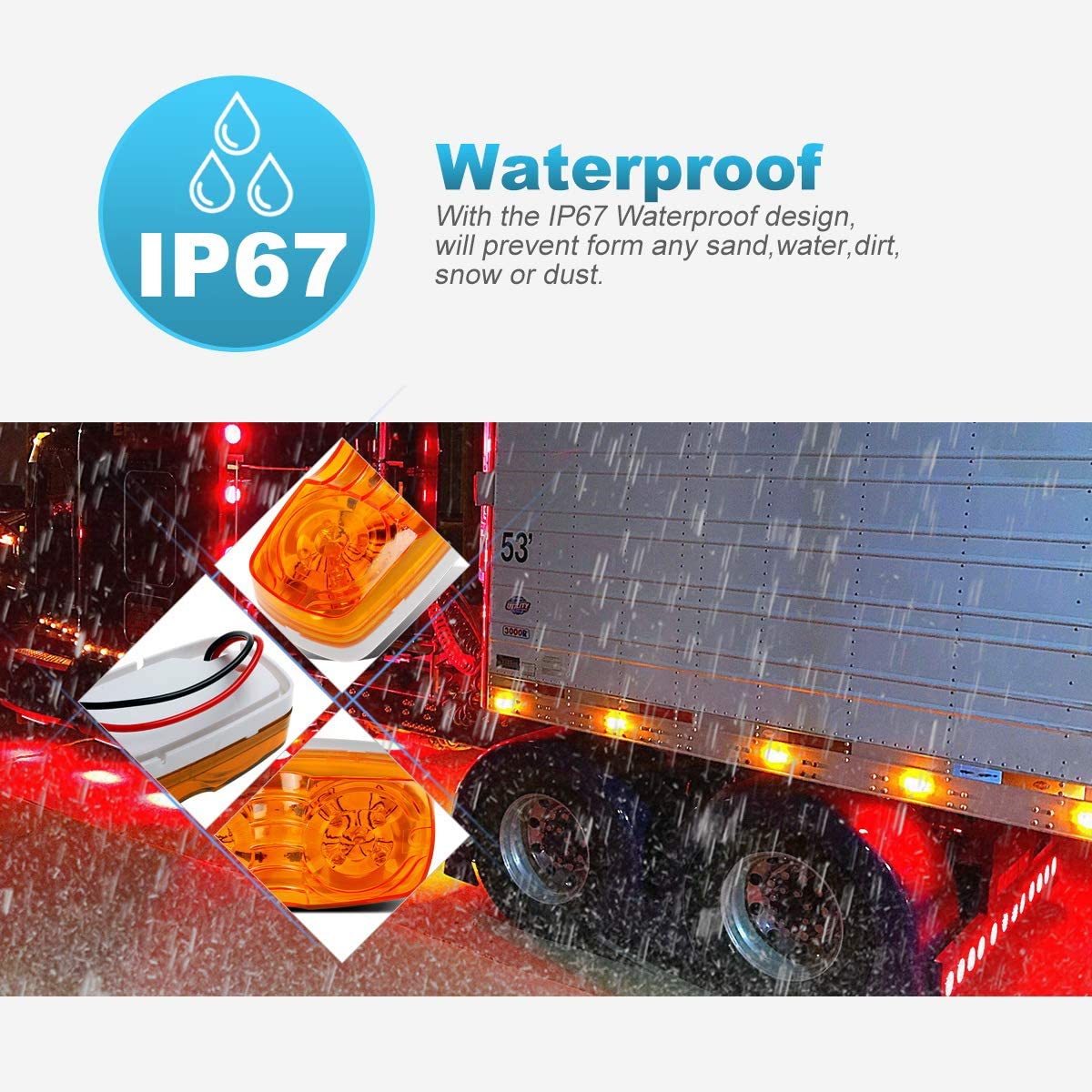
For most trailer owners (especially those with wide trailers), PC-rated combination lights are the best balance of compliance, cost, and convenience. Here’s why:
1. Compliance Guaranteed: PC-rated lights meet FMVSS-108 and SAE J759 standards, so you’ll never fail an inspection for using the wrong light.
2. Lower Installation & Labor Costs: One light instead of two cuts down on drilling, wiring, and setup time—saving money for fleets or DIY owners.
3. Reduced Maintenance: Fewer components mean fewer bulb replacements, wiring repairs, and downtime.
4. Versatility: PC-rated lights work for wide trailers (their primary use) and can replace P2 lights on smaller trailers (if you want a streamlined setup).
When shopping for PC-rated lights, look for trusted manufacturers like Truck-Lite: all their PC-rated lights meet P2 standards (as a baseline) and are DOT-certified, ensuring reliability and compliance.
Final Thoughts: Simplify Compliance With PC-Rated Trailer Lights
Trailer lighting regulations don’t have to be complicated—by understanding SAE J759 codes (especially P2 vs. PC) and matching your light choice to your trailer’s width, you can ensure safety, avoid fines, and reduce long-term costs.
For wide trailers (over 80 inches), PC-rated combination lights are the clear winner: they combine two functions into one, cut installation time, and meet all federal standards. For smaller trailers, P2-rated lights remain the affordable, compliant baseline.
No matter your trailer type, always choose DOT-certified lights from reputable brands (like Truck-Lite) to guarantee performance and compliance.